Look after the machine that makes your mornings, and it keeps making them for years.
The short answer. You can, but it is a poor choice for a bean-to-cup or espresso machine. Vinegar can harden rubber seals over time, leaves a smell and taste that take several rinses to clear, and is not as good at dissolving scale as a descaler made for coffee machines. Use a lactic acid descaler at the dose your manual gives.
Next time, pay less for each descale
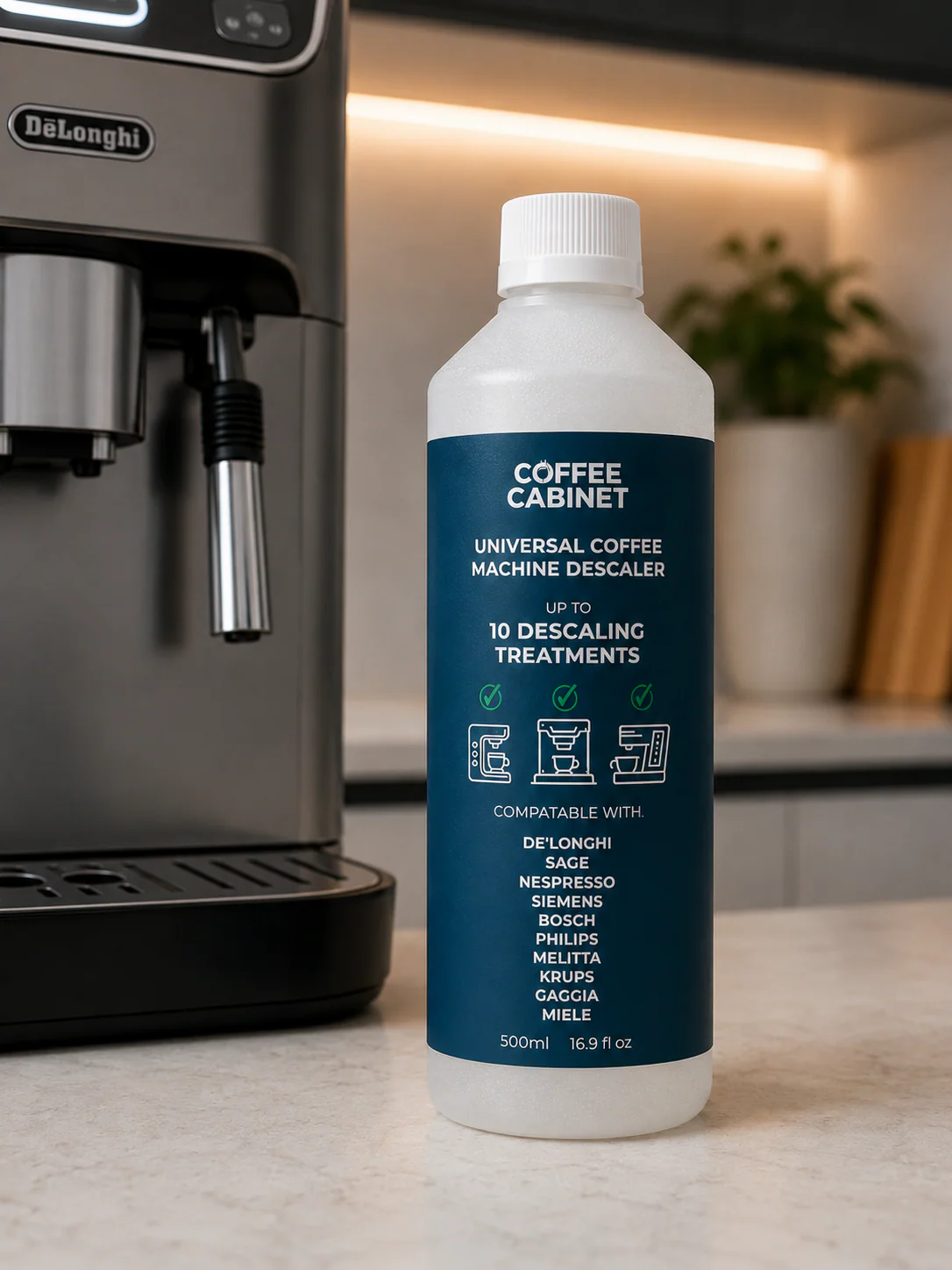
Both are lactic acid descalers and work with your machine's own descale programme. Ours is concentrated, so a 500ml bottle goes a long way.
It is tempting: a bottle of vinegar is in the cupboard and it is cheap. But a bean-to-cup or espresso machine is a few hundred pounds of pumps, seals and fine pipes, and the money saved on a bottle of descaler is not worth the risk to it, or to the taste of the next week's coffee.
What descaling actually does
Tap water carries dissolved minerals, mostly calcium. Heat them, as a coffee machine does a few hundred times a month, and they settle as limescale on the heater and in the pipes. A descaler is a mild acid that dissolves that scale and carries it out, so the heater warms the water properly again and the water flows freely through the coffee.
Why vinegar is a poor choice
- Seals and gaskets. The acetic acid in vinegar can dry out and harden rubber seals over time, the parts that keep your machine from leaking.
- The smell and taste stay. Vinegar is hard to rinse out of a machine's pipes. Coffee can taste of it for days.
- It is not the best at the job. Descalers made for coffee machines are made to dissolve limescale at the dose and temperature the machine uses, without the side effects.
- Your manual says not to. De'Longhi's manuals tell you to use a descaler made for coffee machines. If your machine is under warranty, follow its manual.
What about citric acid?
Citric acid is better than vinegar, but in machines that heat the solution it can leave deposits of its own behind. Lactic acid is what most coffee machine descalers use, including De'Longhi's EcoDecalk and our own Universal Descaler: it dissolves scale well and is gentle on the machine.
What to use instead
A lactic acid descaler made for coffee machines, through your machine's own descaling programme, at the dose in its manual. Our Universal Descaler gives up to 10 descales from one 500ml bottle and works in any bean-to-cup or espresso machine; De'Longhi's EcoDecalk is the one named in De'Longhi manuals.
How to tell your machine needs descaling
- Coffee comes out cooler than it used to.
- It pours more slowly, or the pump sounds louder.
- The crema is thinner and the milk froth is weaker.
- The descale light is on.
Most machines need descaling every one to three months in typical UK water, and sooner in hard water areas. The reminder on your machine, set to your water's hardness, is the best guide: see how often to descale a De'Longhi. A water filter in the tank, if your machine takes one, slows scale down so you descale less often.
Already used vinegar?
Do not worry: one descale with vinegar is unlikely to have done harm. Run two or three full rinses with fresh water until there is no smell, then descale properly with a coffee machine descaler next time it is due. Here is how to descale a De'Longhi step by step.
Keep it running, and fill it with something good
A freshly descaled machine is the best moment to taste what good beans do.
-
Instead of vinegar
Coffee Cabinet Universal Coffee Machine Descaler 500ml
Our own lactic acid descaler: up to 10 descales from a 500ml bottle, for any bean-to-cup or espresso machine.
-
Then, fresh coffee
Miles Italian Espresso Coffee Beans
Dark chocolate with a little orange zest, and so little sharpness that it is as good in a latte as on its own. If you only buy one bag, make it this one.
Medium-dark roast · Strength 4 of 5 · Chocolate, orange, sweet
1kg: buy 3 save 10%, 4+ save 15% · 227g: any 3 for £25 Free tracked UK delivery over £15Save 10% on a planEvery Miles coffee compared
Questions people ask
Is vinegar bad for coffee machines?
It is not ideal. It can harden rubber seals over time and leaves a smell and taste that are hard to rinse out. A descaler made for coffee machines does the job better and is gentler on the machine.
Can I use vinegar in my De'Longhi?
De'Longhi's manuals tell you to use a descaler made for coffee machines, such as EcoDecalk. Follow your manual, especially while the machine is under warranty.
Is citric acid OK for descaling a coffee machine?
It works better than vinegar, but it can leave deposits in machines that heat the solution. Lactic acid descalers, which most coffee machine descalers are, are the safer choice.
How do I get the vinegar taste out of my coffee machine?
Run two or three full rinses with fresh water, using the rinse or hot water function, until there is no smell, then pour away the first coffee or two.
The right descaler, done properly.
A lactic acid descaler made for coffee machines, up to 10 descales in every bottle.
Not needed today? Get our machine-care tips, and 10% off your first order for when you do.